Wednesday, 22 March 2017

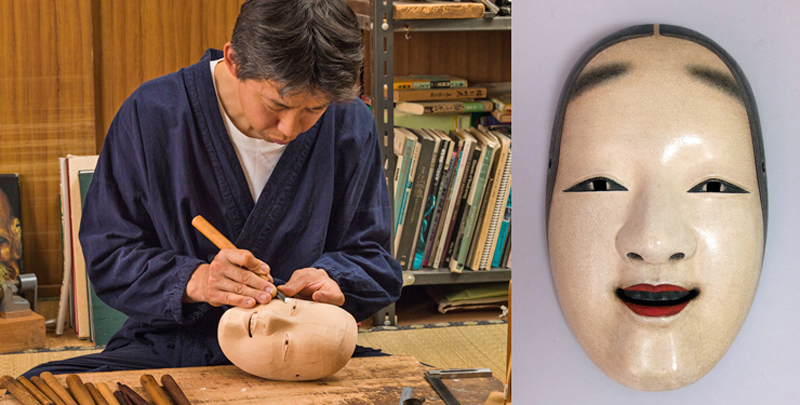
Japanese Master Carver, Hideta Kitazawa, at the Pitt Rivers Museum


Man sitting cross legged on a  small stage carving a mask.
Japanese Master Carver, Hideta Kitazawa © Pitt Rivers Museum 


In February 2017 Hideta Kitazawa, a Japanese Noh theatre mask carver visited the Pitt Rivers Museum, Oxford, to demonstrate his skills to the public. Kitazawa-san was visiting the UK to deliver a mask that he had recently carved that was to be used in a Noh theatre performance in London, and was running a range of workshops and demonstrations as part of a trip in parnership with the Japan Foundation.


Close up of a chisel being used to carve a wooden mask
Carving a Noh Mask © Pitt Rivers Museum

This short film shows the artist at work on the Clore Learning Balcony of the museum. It was an incredible success. Kitazawa-san is a natural performer and communicator and the public were mesmerised by his work. Some people sat and watched for up to three hours, and on the Saturday the museum received a record number of visitors, over three and a half thousand.

Hideta Kitazawa had previously visited in 2009 to run similar workshops. In 2015 the museum commissioned Kitazawa-san to carve three masks to show the processes that he uses. These are now on display in the museum (PRM 2015.28.2-4) as part of an HLF funded re-display and public engagement project  Need Make Use. There is no doubt that he is a master carver and my personal favourite is a mask that he was commissioned to make for the Williamette Theatre in Oregon US, it’s a mask of Frida Kahlo.

Hideta Kitazawa carves a mask of Frida Kahlo
Carving a mask for the © Pitt Rivers Museum

I feel very privileged to have worked with Kitazawa-san on two occasions. I particularly enjoyed being referred to as Andy-san. The highlight for me was when Kitazawa-san ran an informal workshop with students from Rycotewood Furniture Centre as part of the museum's HLF funded Need Make Use project. The two-way discussion of tools, materials and processes was truly inspiring. I’m looking forward to the next visit. This is a picture of my son wearing one of Kitazawa-san's masks.

Child holds up a Not Mask in front of his face
Wearing one of Kitazawa-san's Masks© Pitt Rivers Museum

Andy McLellan
Head of Education and Outreach
Pitt Rivers Museum 2017

Monday, 13 March 2017

City primary schools get to be Curious Curators!

The project Curious Curators gave pupils a chance to find out more about what goes on in Oxford's University Museums and develop literacy, research and presentation skills.  Over 400 Year 4/5 city primary school pupils were involved in this cross-curricular project which placed objects at the centre  of the learning experience.  The project was enabled by an OUMP innovation fund and allowed The Ashmolean, the Oxford University Museum of Natural History, the Museum of the History of Science and the Pitt Rivers Museum to work with 7 city schools.
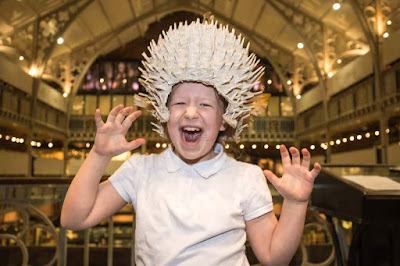
Girl wearing a large brown, spiky hat which is a replica of a porcupine fish helmet
Replica Porcupine Fish Helmet © Pitt Rivers Museum


What did we do at the Pitt Rivers?

As the Primary School Education Officer I worked with a Year 4 and a Year 5 class from both St John Fisher Catholic Primary School and St Andrews CofE Primary School.  Each class visited the Museum twice with a gap of two weeks to allow the pupils to prepare their presentation on key items in the collection.   During the first visit pupils focused on one object and explored lots of different ways of engaging audiences with that object.  The object we chose to look at was the porcupine fish helmet from Kiribati, a group of Pacific islands.  Pupils had a great time trying on a replica helmet, modelling their own fish helmet from plasticine and asking a range of questions.  I particularly liked the questions: Was the fish killed while puffering? Did you steal this object? and Do you need gloves to pick it up?

Two boys hold up model plasticine helmets they have made on the end of their fingers
Plasticine Helmets © Pitt Rivers Museum


In small groups pupils were then allocated an object in the collection which they had to research and go away and prepare a multi-sensory presentation on.  By working closely with the class teachers we were able to choose objects which matched their classroom topic.  One class explored Mythical Beasts so we discovered hippocampi (Greek mythological sea-horses!) and dragon serpents lurking in the Museum, whilst another class explored Ancient Egyptian artefacts.


Several pupils peer over a case looking for a specific object
Spotting an Ancient Egyptian 'pencil' case in the Museum © Pitt Rivers Museum


In the second visit pupils gave their presentations which were incredibly fun and engaging.  I had modelled different ways of engaging visitors with an object in the first session but they seemed quite sedate in comparison to what the pupils produced!  We experienced Egyptian dances, listened to raps, watched stop motion films, helped to create a lion's mane and all had a go at making origami frogs. It was a great pleasure to see the pupils owning the Museum space and having the confidence to present and perform in a public arena.

Group of pupils prepare a person for mummification with a backdrop of the pyramids on the screen behind them
Preparing a person for mummification in Ancient Egyptian presentation
© Pitt Rivers Museum

Finally, pupils had the opportunity to meet a real curator, Faye Belsey, who told us a bit more about what goes on behind the scenes in a Museum.  Pupils found out how objects get organised and recorded whilst also discovering how they are protected from hungry insects - they should all know what moth poo looks like now having had a hands-on experience!

Pupils hand round a bag containing moth poo
Handling moth poo! © Pitt Rivers Museum

What now?

This pilot project enabled museum education staff to work alongside primary school teachers to explore how museums can be used to support learning in a cross curricular way.  We hope it will pave the way for schools to access the collections of their local museums in a creative way when exploring a classroom topic. Objects really can bring topics to life and if those objects are nearby why not go and see them?

If you would like to discuss ideas for a possible Curious Curator session please contact rebecca.mcvean@prm.ox.ac.uk

Becca McVean
Education Officer (Primary)


Wednesday, 22 February 2017

Awesome Aboriginal Arts Award project at Iffley Academy


Throughout the Autumn term of 2016 we worked with a Key Stage 4 class at Iffley Academy in Oxford on a print-making project inspired by Aboriginal Art in the Pitt Rivers Museum.  Iffley Academy is a community Special Academy for children and young people up to the age of 18 with special educational needs. Each of the participating students created an Arts Award Explore portfolio as part of the project. Arts Award Explore is a nationally recognised Entry Level 1 Qualification. 

We began the term by meeting each other on skype. The class prepared a series of questions for me (I am the secondary education officer at the Museum) about the Pitt Rivers Museum and what I do here. It was a great chance to ‘e-meet’ each other and talk about what we were going to do in the project before I visited the school for the first time.

After that I visited the school, when I took along a selection of Aboriginal objects from our handling collection.  These included two boomerangs with painted designs, woven baskets and large reproductions of some of the beautiful Aboriginal paintings in the collection. We learnt about how to handle delicate objects carefully, and thought about what these things were made out of and what they were used for. For example how skilled Aboriginal basket weavers are and how they make baskets out of natural materials. We then discovered a bit about Aboriginal culture and painting. We discovered how ancient Aboriginal culture is, and how many artworks depict scenes and figures from the Dreaming. The Dreaming is the word outsiders use to describe the way Aborigines look at the world. It is based upon timeless stories featuring mythological creatures and ancestors, whose actions resulted in the creation of the landscape, animals and the Aboriginal people.

Next each student did a drawing and took a photograph of their favourite object.

Woven bag made from pandanus leaves painted with ochre colour
Dilly bag made of pandanus fibre, 
painted with red ochre 
© Pitt Rivers Museum 
Woven basket made from pandanus leaves
Woven basket made of pandanus fibre
© Pitt Rivers Museum 
Curved boomerang with painted decoration of a kangaroo
Curved boomerang with painted decoration of a 
kangaroo © Pitt Rivers Museum  
Replica wooden boomerang with painted decoration of a geko
Replica boomerang with painted decoration of a geko
© Pitt Rivers Museum 
Then came the students’ trip to the museum. It was fantastic to welcome the group here. They came with so many questions and put their drawing skills to full use. We took a close look at the Aboriginal paintings and also visited the Conversation studio and the Education team office.

Photograph of group of students standing in education staff office at Pitt Rivers Museum
Students visiting the colourful Pitt Rivers Education Office © Pitt Rivers Museum
Photograph of a group of students looking at a painting by Aboriginal artist Yirawla. The painting is on bark and is of the Rainbow Snake, done in the 'X-ray style' of painting
Looking at painting by the artist Yirawala,
from the Gunwingg community in Northem
Arnhem Land. The painting is on bark and
is of the Rainbow Snake, done in the
'X-ray style' of painting © Pitt Rivers Museum


Brightly-coloured painting on canvas by the Aboriginal artist Judy Napangardi
Painting on canvas by the artist 
Judy Napangardi Watson, 1994.43.1 
© Pitt Rivers Museum
Photograph of two students drawing in the Pitt Rivers Museum
Drawing in the Museum © Pitt Rivers Museum
Photograph of student making drawings of Museum objects in his sketchbook
Drawing in the Museum © Pitt Rivers Museum
After the visit each student created their own poster about the Museum, presenting all their research so far. Then they chose one of their drawings to turn into a printed design. After that the textile artist Ellen Love came into school for an amazing collagraph printing workshop. The students transferred their designs onto a printing board, then used a special safe cutting knife to mark their design into the board.  

They then built up textures by cutting aware more cardboard, or adding small pieces of masking tape. Ellen showed us how to add ink to the board (using gloves!) and then make sure excess ink was removed using a special piece of muslin cloth called ‘scrim’. Finally it was time to use Ellen’s printing press! Each student made three prints from their board.
Photograph of artist adding ochre-coloured ink to printing board in preparation for making a print
Inking the board © Pitt Rivers Museum

Student scrubbing inked board with cloth to remove excess ink before printing
Scrubbing with the 'scrim' to remove excess ink
© Pitt Rivers Museum 

Student holding up their print board showing their design of a snake covered with ink
Board ready for printing © Pitt Rivers Museum

Photograph of student placing their inked board on the printing press
Placing the board on the collagraph printing press
© Pitt Rivers Museum

Photograph of printing board in place on printing press ready for printing
Placing the board on the collagraph printing press
© Pitt Rivers Museum

Photograph of student peeling their print of a lizard away from the print board after printing
Revealing the print © Pitt Rivers Museum

Paper with print being lifted from the print board showing picture of a human
Revealing the print © Pitt Rivers Museum

After our workshop with Ellen, students carried on working on two of their prints to add more colour and texture.

Once all the artwork was complete it was time to make a presentation about what we’d learnt and what we’d made. The students used the excellent ‘Explain Everything’ app to create a presentation about their learning and artwork. Some of the students chose also to present to Ellen and me in person.

Photograph of student presenting their Arts Award portfolio to their teaching, showing them the artwork they have made
Student presenting their project work to their teacher as part of
achieving their Arts Award Explore qualification
© Pitt Rivers Museum
A huge well done to all eleven students for completing their Arts Award portfolios, creating some truly beautiful work, and for learning about lots of different aspects of Aboriginal art and culture.  
Katherine Rose
Education Officer (Secondary and FE)
Pitt Rivers Museum


Saturday, 28 January 2017

Meet Me at the Museum - Around the World in Our Treasures

Over the past year I have been working with wonderful older people from across Oxfordshire, welcoming them in to the Pitt Rivers as part of the Meet Me at the Museum programme.

Meet Me at the Museum is an opportunity for older people and those living with Dementia to bring their curiosity and their continued thirst for learning to the Pitt Rivers. Every first Monday of the month we have been spending two hours together touring the galleries and handling objects that tell the story of the museum and bring to life the cultures behind the objects.

Photo of an African mask which was handled during the session
Object Handling, Meet Me at the Museum © CDAN 

Our first season of MMAM at the museum was in partnership with Creative Dementia and Arts Network (CDAN) Flourish funded artist, Charlie Henry. In collaboration with Charlie we shared our own special stories and objects, which culminated in Around the World in Our Treasures. This co-produced exhibition showcased our spoken memories and personal objects through a wonderful set of stop-animations that brought the objects to life.


Two people standing in front of a case which has the Treasures Exhibition inside it
Around the World in Our Treasures ©Pitt Rivers Museum

One of the most important aspects of this programme was that everyone in the group - carers, older people, people living with Dementia, volunteers and staff -  shared their object stories. This created an equality of purpose. Having had experience as a carer for someone living with Dementia, carers are not always actively engaged in the activities provided. Meet Me at the Museum is an opportunity to see the person you care for as having the ability to take part, contribute and to learn. Most importantly, it is also an opportunity to socialise with others living similar lives and to go away having learnt and contributed something yourself. MMAM has further highlighted to me the importance of ensuring that museums continue to develop opportunities for vulnerable older people to participate and make meaningful contributions to our museum activity. 


Two people looking into a museum case of objects
Touring the Museum  ©CDAN


This month we have widened the group further to include older people who would probably not think of themselves as vulnerable. This has changed the dynamic again – creating more active discussion and empowering some of our vulnerable members to participate with confidence.  We are currently looking at life stages and the rituals and ceremonies that we use to mark these. So far, we have covered birth, childhood to adulthood, and marriage, so we have heard lots of good stories!

If you are interested in finding out more about this group or in joining in then please contact me - Beth - on 01865 613004. Our sessions run every 1st Monday of the Month.

Beth McDougall
VERVE Activities Officer